











December 2025
Digital twins are the core for aerospace's shift toward predictive, model-driven, and lifecycle-oriented engineering and operations. By linking high-fidelity simulation with real-time sensor data and operational context, digital twins provide continuously updated virtual representations of physical assets and processes, from individual components to entire aircraft fleets, production systems, and operations. This convergence of models, real-time telemetry, and analytics accelerates the transition from document-centric workflows to integrated digital thread environments, where design intent, configuration, performance, and sustainment are connected throughout long operational lifecycles.
However, digital twin adoption faces significant technical, organizational, and regulatory headwinds. Data is often fragmented across legacy systems, while building and maintaining high-fidelity models remains costly and skills-intensive. Accuracy must be sustained as configurations change and assets age, requiring rigorous Verification, Validation, and Governance (VV&G). Security, IP protection, and data sovereignty constraints further complicate collaboration across OEM ecosystems, suppliers, operators, and MROs (Maintenance, Repair and Operations organizations). Regulatory acceptance of simulation-backed evidence also remains uneven across jurisdictions and certification domains.
Because digital twins increasingly inform safety-critical decisions in areas such as certification, maintenance, mission readiness, and flight operations, they are subject to security and reliability requirements closer to those of operational systems than conventional analytics tools. Rigorous cybersecurity, system integrity, availability, and fault tolerance considerations often slow deployment and limit the speed at which twins can be embedded into live workflows. Adoption is therefore incremental, prioritizing high-value, well-bounded use cases where data availability and benefits are clear, with expanding scope as confidence and regulatory maturity increase.
In this report, we apply Tolaga Intelligence’s analytical frameworks to examine the evolving landscape for digital twins in aerospace. We assess aerospace's relative maturity compared with other industry verticals, identify leading solution providers, and examine key use cases, real-world deployments, adoption challenges, and implications for producers, technology vendors, investors, and policymakers. In addition, the report maps the digital twin landscape through a use-case lens, highlighting where measurable value is being realized, the solution provider ecosystem, and how leading organizations embed digital twins into core processes to improve performance, resilience, safety, and lifecycle economics.
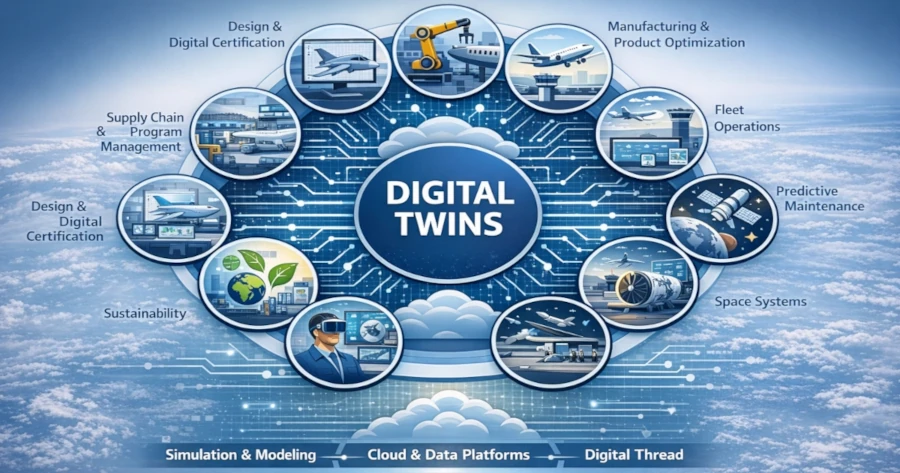
Digital twins are increasingly deployed across the aerospace lifecycle, including design and digital certification, manufacturing, fleet operations, predictive maintenance, space systems, defense readiness, sustainability, workforce training, and supply chain management. Supported by integrated engineering platforms, high-fidelity simulation, cloud infrastructure, and digital thread technologies, these systems enable a shift from document-centric workflows toward predictive, model-driven decision support. Taken together, these deployments establish digital twins as core infrastructure for managing safety, performance, sustainability, and readiness across complex aerospace programs.
Natural language processing (NLP) and AI tools were used to identify companies mentioned in the content corpus, measure their prevalence (BREADTH), and evaluate how frequently they appear alongside other companies (DEPTH). Of the 183 companies identified, the ranking of the top 10 is shown in the chart below.
Siemens applies digital twins in aerospace through Teamcenter, NX, Simcenter, and Opcenter, creating an end-to-end, simulation-driven digital thread that connects design, certification, manufacturing, and in-service operations to reduce program risk, accelerate development, and support regulator-ready compliance.
Dassault Systemes applies digital twins in aerospace through the 3DEXPERIENCE platform to create a persistent virtual model that connects design, simulation, manufacturing, certification, and in-service operations, reducing development time and certification risk while improving lifecycle performance.
Boeing uses digital twins to create authoritative, model-based representations of aircraft and systems that support accelerated development, model-based certification, and lifecycle sustainment across design, manufacturing, and in-service operations.
Lockheed Martin uses digital twins as part of a model-based engineering approach to create high-fidelity, physics-based representations of aerospace systems that accelerate development, support certification, and enable predictive sustainment across the full lifecycle.
Microsoft Azure enables aerospace digital twins by providing a cloud-based platform that integrates operational data, IoT, and AI with engineering models to support fleet performance, predictive maintenance, and lifecycle optimization at scale.
IBM applies digital twins in aerospace by combining AI, hybrid cloud, and systems integration to link engineering and operational data, enabling predictive maintenance, operational optimization, and lifecycle decision intelligence.
Airbus uses digital twins to create end-to-end virtual representations of aircraft that connect design, simulation, manufacturing, certification, and operations, reducing development risk while improving industrial efficiency and lifecycle performance.
Rolls-Royce uses high-fidelity digital twins of aircraft engines, combining physics-based models with real-time operational data, to enable predictive maintenance, optimize performance, and support its TotalCare in-service engine services.
NASA uses high-fidelity, physics-based digital twins to simulate, validate, and monitor aerospace and space systems across design, testing, and mission operations to reduce risk and improve mission safety and reliability.
Capgemini applies digital twins in aerospace as an integration- and analytics-led capability that connects engineering, manufacturing, and operational data to improve efficiency, sustainability, and lifecycle decision-making.
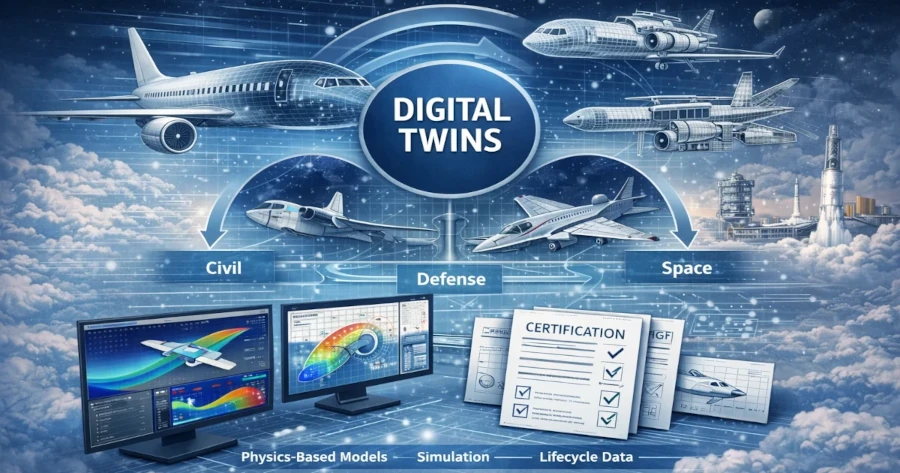
In aerospace design and engineering, digital twins create high-fidelity virtual representations of aircraft, spacecraft, propulsion systems, and subsystems that evolve alongside physical development. By integrating physics-based models, advanced simulation, and design data, these twins enable evaluation of structural integrity, aerodynamics, thermal performance, and system interactions across a wide range of operating conditions. Extensive virtual testing and rapid iteration reduce reliance on physical prototypes, shorten development cycles, and support model-based systems engineering. Increasingly, digital twins also underpin digital certification by providing traceable, simulation-backed evidence aligned with regulatory requirements.
Several major solution providers enable these capabilities through integrated digital engineering and certification platforms. Dassault Systèmes, through its 3DEXPERIENCE platform incorporating CATIA, SIMULIA, and ENOVIA, supports high-fidelity product and system digital twins that integrate multiphysics simulation with requirements and configuration management, enabling continuous digital threads and simulation-backed certification workflows. Siemens Digital Industries Software delivers an end-to-end toolchain through Teamcenter, NX, Simcenter, and Capital, widely used for multiphysics, avionics, and systems integration modeling, and for generating auditable, regulator-ready digital evidence early in certification processes.
Specialist simulation providers complement these platforms by supplying high-fidelity physics-based models for safety-critical use cases. ANSYS is widely used for aerodynamics, structures, thermal analysis, electromagnetics, and fluid dynamics, with simulations frequently supplementing physical testing by addressing edge-case conditions that are difficult or costly to validate experimentally. Altair Engineering contributes advanced simulation and optimization tools used extensively in structural design and lightweighting, enabling topology optimization, early trade-off analysis, and certification support for composite and next-generation materials.
Product lifecycle management (PLM), digital thread, and enterprise technology providers play a critical role in traceability and governance. PTC, through Windchill and Creo, enables model-based product definition, requirements traceability, and configuration control across engineering and validation activities, supporting auditable digital certification workflows. IBM provides systems engineering, digital thread, and lifecycle data management solutions, particularly in defense and space programs, enabling authoritative digital models to serve as certification artifacts aligned with government digital engineering strategies.
Cloud and validation technologies further enable certified digital twins at scale. Microsoft Azure and AWS provide the scalable infrastructure required for high-performance simulation, management of large engineering datasets, and secure, collaborative certification workflows across distributed teams. Hexagon, through its simulation, metrology, and digital reality portfolio, supports digital certification by correlating physical test data with digital models, helping validate that digital twins accurately reflect real-world behavior.
Leading aerospace manufacturers increasingly embed these capabilities directly into design and engineering workflows. Airbus applies high-fidelity digital twins across programs such as the A350 and A320neo as part of its Digital Design, Manufacturing, and Services initiative, supporting virtual validation and simulation-backed certification aligned with EASA and FAA requirements. Boeing has advanced digital certification through its digitally engineered T-7A Red Hawk program and now engages regulators using model-centric evidence across commercial and defense platforms. In propulsion, Rolls-Royce applies digital twins throughout engine design and qualification to reduce physical test cycles and supplement certification with traceable simulation outputs.
Defense and space programs have been early adopters of digital certification. Lockheed Martin uses digital twins across aircraft and mission systems to support structural validation, systems integration, and airworthiness assessments in alignment with US Department of Defense digital engineering strategies. Dassault Aviation leverages end-to-end digital continuity to streamline certification for business jet and military aircraft variants, enabling earlier regulatory engagement. Beyond aviation, NASA relies on digital twins to certify spacecraft designs and mission readiness in environments where full physical testing is impractical, using simulation to assess extreme thermal, structural, and operational conditions.
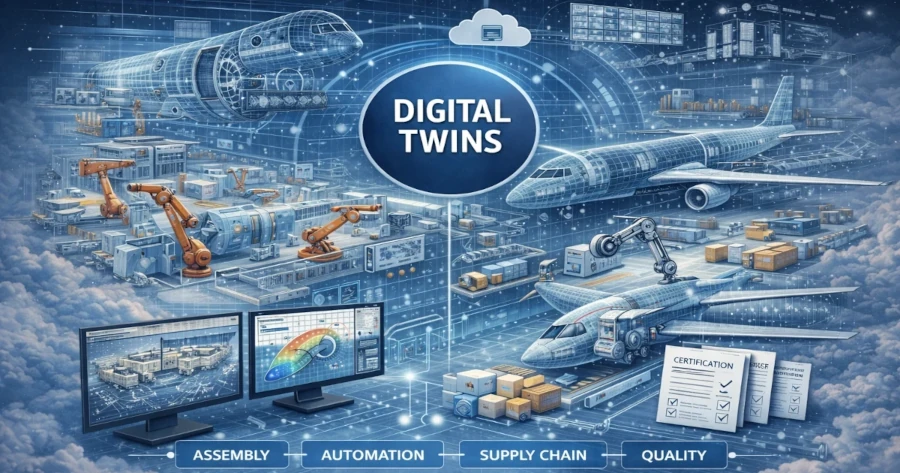
In aerospace manufacturing, digital twins replicate production lines, tooling, robotics, and assembly processes to improve efficiency, quality, and throughput. These manufacturing twins enable virtual validation of factory layouts, assembly sequences, automation strategies, and material flows before changes are deployed on the shop floor. When connected to real-time production data, they allow manufacturers to identify bottlenecks, reduce scrap and rework, improve schedule adherence, and better coordinate complex, multi-tier supply chains.
Several major solution providers enable manufacturing and production digital twins by connecting design intent with factory execution. Dassault Systèmes, through its 3DEXPERIENCE platform, supports end-to-end digital manufacturing by integrating product lifecycle management (PLM), manufacturing planning, and simulation to create virtual replicas of production systems. Siemens Digital Industries Software, using Teamcenter, Tecnomatix, NX, and Opcenter, enables manufacturers to model, simulate, and optimize assembly processes, automation, and production workflows while maintaining traceability to engineering data. PTC, through Windchill and its manufacturing execution ecosystem (MES), supports digital thread continuity between engineering definitions, manufacturing plans, and shop-floor execution.
Industrial simulation providers contribute detailed, physics-based process models required for advanced aerospace manufacturing. ANSYS and Altair Engineering provide simulation tools used to model composite layup, machining, additive manufacturing, thermal behavior, and structural response during production. These simulations help manufacturers optimize process parameters, improve first-time-right outcomes, and reduce material waste. When integrated with live production data, these models support closed-loop optimization, allowing manufacturing twins to be continuously refined based on observed performance.
Automation, robotics, and industrial IoT vendors embed digital twins directly into production environments. Providers such as ABB, KUKA, Fanuc, and Siemens enable virtual commissioning of robotic cells and automated lines, allowing control logic, safety constraints, and throughput scenarios to be tested digitally before installation. Industrial connectivity platforms and sensor providers feed real-time data from machines, tools, and inspection systems into manufacturing twins, enabling predictive quality monitoring and early detection of non-conformances.
Cloud and data platform providers play an enabling role by supporting the scale and collaboration required for aerospace manufacturing digital twins. Microsoft Azure and AWS provide infrastructure for managing large volumes of design, simulation, and production data across globally distributed factories and suppliers. These platforms support collaborative manufacturing twins that connect engineering, production, quality, and supply chain teams in near real time.
Aerospace manufacturers are increasingly deploying manufacturing digital twins to manage complex, low-volume, high-precision production environments. Airbus uses production digital twins across final assembly lines for aircraft such as the A320 and A350 to validate tooling, assembly sequences, automation integration, and material flow before execution, improving schedule adherence across distributed sites. Boeing applies manufacturing twins across commercial and defense programs to assess assembly changes, validate robotic automation, and evaluate the production impact of late-stage design changes.
Dassault Aviation uses manufacturing digital twins to optimize production of Falcon business jets and military aircraft by simulating assembly operations, tooling constraints, and tolerance stack-ups early in the lifecycle. Lockheed Martin applies production digital twins across aircraft, missile, and space programs to optimize factory layouts, validate automated drilling and fastening, and dynamically adjust production plans using real-time shop-floor data. Rolls-Royce deploys digital twins across advanced engine manufacturing processes, including additive manufacturing and precision machining, to optimize yields, reduce scrap, and manage quality risk in high-cost propulsion components.
At the ecosystem level, aerospace manufacturers increasingly use manufacturing digital twins to model supplier performance, logistics flows, and production dependencies across distributed supply networks. These capabilities enable scenario testing for disruptions, capacity constraints, and production ramp-up strategies, supporting greater resilience as aerospace programs face supply chain volatility, workforce constraints, and pressure to scale production while maintaining stringent quality and safety standards.
In aircraft and fleet operations, digital twins integrate real-time flight data, environmental conditions, and operational parameters to model aircraft and fleet performance continuously. These twins enable airlines and operators to analyze fuel efficiency, benchmark performance across routes and operating conditions, and simulate scenarios such as weather disruptions, demand changes, or aircraft unavailability. At the fleet level, digital twins support optimization of utilization, cost, and reliability while maintaining safety and regulatory margins.
Solution providers deliver these capabilities through operational analytics platforms that connect aircraft, engines, and fleets. GE Aerospace and Rolls-Royce embed digital twins into engine and aircraft performance platforms to model fuel burn, health, and degradation across routes and mission profiles. Airbus Skywise, Boeing AnalytX, and Lufthansa Technik provide fleet-level digital twin platforms that integrate flight data, maintenance records, and operational context, enabling benchmarking, schedule simulation, and disruption management across entire fleets.
Cloud and data platforms such as AWS, Microsoft Azure, and Palantir provide the scalable infrastructure required to process large volumes of operational data and support collaborative, real-time decision-making across airline operations centers. Specialist airline operations providers including Sabre, Amadeus, and NavBlue embed digital twin concepts into scheduling, dispatch, and network optimization systems, allowing operators to evaluate trade-offs between cost, reliability, and customer service.
Real-world deployments demonstrate measurable impact. Airbus Skywise is used by airlines such as Delta, easyJet, AirAsia, and Lufthansa Group to improve fuel efficiency and dispatch reliability. GE Aerospace and Rolls-Royce report fuel savings, extended on-wing time, and reduced disruptions through engine digital twins. Airlines such as Delta and easyJet use operational digital twins to improve on-time performance, reduce cancellations, and optimize fuel and emissions. Defense organizations apply similar fleet readiness twins to forecast availability and manage high-value assets under varying operational conditions.
Collectively, solution providers are shifting fleet operations from reactive management toward predictive, model-driven decision support. Digital twins are increasingly core operational systems that improve utilization, reduce operating costs, and enhance reliability at scale.
Predictive maintenance is one of the most mature aerospace digital twin applications. By continuously ingesting sensor data from engines, structures, and onboard systems, digital twins model component degradation and estimate remaining useful life. This enables condition-based maintenance, reducing unplanned downtime, lowering maintenance costs, extending asset life, and improving availability, particularly for long-life, high-value aerospace platforms.
Engine OEMs are the primary solution providers in this domain. GE Aerospace, Rolls-Royce, and Pratt & Whitney deploy engine digital twins across global fleets to monitor wear, thermal stress, and performance drift under real operating conditions. These twins enable targeted maintenance interventions, reduced unscheduled removals, and longer on-wing time.
At the aircraft and fleet level, Airbus Skywise, Boeing AnalytX, and Lufthansa Technik provide predictive maintenance platforms that integrate flight data, maintenance history, inspections, and environmental factors. These solutions support early fault detection across avionics, structures, landing gear, and auxiliary systems, reducing aircraft-on-ground events and improving maintenance planning.
System suppliers such as Safran, Honeywell Aerospace, and Collins Aerospace embed predictive maintenance capabilities into avionics, flight controls, and auxiliary power units. Simulation and analytics providers, including Siemens, ANSYS, and Altair, supply the physics-based models and multiphysics analytics that underpin accurate degradation and life prediction. AWS, Microsoft Azure, and Google Cloud enable these solutions at scale by supporting real-time data ingestion, analytics, and global collaboration.
Together, these providers are shifting maintenance from predominantly schedule-based inspection toward data-driven, predictive capabilities that can materially reduce sustainment costs and improve fleet availability where fully implemented.

Digital twins are used in space systems to support mission planning, execution, and anomaly resolution, especially in environments where physical access to assets is either impossible or severely constrained. High-fidelity virtual representations of spacecraft, satellites, and payloads simulate orbital dynamics, propulsion behavior, thermal conditions, and system interactions throughout mission lifecycles. These models enable operators to rehearse missions, diagnose anomalies, and validate corrective actions before implementation. By providing detailed what-if analyses and predictive insights, digital twins extend mission lifetimes, reduce operational risk, and enhance the resilience of space programs.
Space agencies are among the most advanced users of mission-level digital twins, often acting as both operators and solution developers. Organizations such as NASA, ESA (European Space Agency), and JAXA (Japan Aerospace Exploration Agency) integrate digital twin technologies into mission design, planning, and control environments. NASA has pioneered their use of digital twins across programs, including Orion, the James Webb Space Telescope, and multiple Mars exploration missions. In these contexts, digital twins simulate extreme thermal, structural, and operational conditions, enabling mission rehearsal, risk assessment, and decision support where physical testing or intervention is not feasible.
Major aerospace and defense primes, including Lockheed Martin, Northrop Grumman, Boeing, and Airbus Defence and Space, play a central role in delivering digital twin solutions for mission assurance, systems integration, and anomaly analysis. Their implementations combine systems engineering models, mission simulations, and real-time telemetry to support both planning and in-orbit operations. By allowing crews and analysts to test corrective actions virtually before execution, these models help extend asset lifetimes and improve confidence in mission performance under constrained operating conditions.
Specialist software providers supply the mission modeling and orbital analysis frameworks that underpin these twins. ANSYS provides its Systems Tool Kit (STK), which is a widely adopted platform for orbital mechanics, coverage analysis, and constellation management. Government agencies, defense organizations, and commercial operators use these tools to plan missions, assess connectivity, and evaluate operational trade-offs across dynamic scenarios.
High-fidelity simulation vendors such as ANSYS, Siemens Digital Industries Software, and Dassault Systemes provide multiphysics modeling tools for propulsion, thermal, structural, and systems integration. These capabilities support precise modeling of long-duration environmental effects such as degradation, thermal cycling, and structural fatigue, enabling earlier anomaly detection and greater predictive reliability.
Cloud and data platform providers increasingly underpin mission-level digital twins by offering scalable infrastructure for telemetry ingestion, high-performance simulation, and collaborative operations. AWS, Microsoft Azure, and Google Cloud enable near-real-time analytics, machine-learning-based anomaly detection, and secure global collaboration across distributed mission teams. These capabilities are now frequently integrated into modern mission control environments to strengthen operational resilience.
Commercial space operators are beginning to extend digital twin adoption beyond bespoke missions to larger satellite constellations. Companies such as Planet Labs, Spire Global, and Maxar apply twin-based models to monitor fleet health, optimize tasking, and manage anomalies at scale. While these implementations currently offer lower fidelity than highly customized mission-specific twins, they represent an essential step toward scalable, data-driven operations across the commercial space sector.
Defense aerospace programs increasingly rely on digital twins to enhance mission readiness, survivability, and decision-making in complex and contested operating environments. These digital representations support mission rehearsal, threat modeling, and platform performance analysis across a wide range of operational scenarios. They are also used to forecast readiness levels, assess the impact of upgrades or retrofits, and optimize sustainment strategies across fleets. By linking design, operational, and sustainment data through continuous digital threads, defense organizations gain clearer visibility into capability gaps, lifecycle costs, and overall force readiness.
Defense prime contractors act as both system integrators and solution providers for mission readiness digital twins, embedding these capabilities directly into aircraft, mission systems, and command environments. Lockheed Martin applies digital twins across combat aircraft, space, missile, and integrated air and missile defense programs to support mission rehearsal, survivability analysis, and readiness forecasting. These twins combine platform performance models, threat libraries, and operational data, enabling defense organizations to simulate contested scenarios, evaluate tactics, and understand the readiness implications of configuration changes, upgrades, or mission profiles.
Boeing Defense, Space & Security delivers digital twin–enabled mission readiness solutions across fighter, trainer, rotorcraft, and autonomous systems programs. Its platforms support system-of-systems modeling, mission effectiveness analysis, and lifecycle sustainment optimization. By integrating design data with operational performance and maintenance history, Boeing enables defense customers to forecast readiness, evaluate retrofit impacts, and manage fleet availability under evolving operational requirements.
Northrop Grumman focuses on digital twins that enhance mission resilience, survivability, and sustainment across airborne, space, and missile defense platforms. Its solutions integrate mission planning, threat modeling, and platform performance data to support readiness analysis in highly contested environments. Digital twins are used to assess how new sensors, software changes, or system upgrades affect mission outcomes and force posture, providing predictive insight prior to operational deployment.
Contributing at the subsystem and mission system level, Raytheon (RTX) delivers digital twin capabilities across avionics, sensors, weapons, and command-and-control systems. These solutions enable detailed modeling of sensor performance, electronic warfare conditions, and system interoperability under complex threat environments. By supporting virtual mission rehearsal and integration testing, Raytheon’s digital twins help defense organizations identify risks and performance trade-offs before live operations or field upgrades.
BAE Systems applies digital twins across defense aviation, naval, and electronic systems to improve mission readiness and long-term lifecycle management. Its platforms support fleet-level readiness forecasting, survivability modeling, and sustainment optimization, particularly for long-life military assets. By maintaining digital continuity across design, upgrades, and operational data, BAE enables customers to manage obsolescence, identify capability gaps, and sustain mission effectiveness over decades-long service lives.
Underlying these deployments is an ecosystem of defense-focused software and simulation providers. ANSYS, Siemens Digital Industries Software, and Dassault Systemes supply multiphysics simulation, systems engineering, and digital thread solutions to model platform behavior, integration, and lifecycle performance. These tools enable rigorous what-if analysis, configuration control, and validation required for trusted readiness assessment and certification.
Finally, data integration and analytics providers such as Palantir, IBM, and C3 AI integrate digital twins into operational decision-making. By integrating data from design, operations, logistics, and intelligence systems, their platforms deliver a unified view of force readiness, mission risk, and lifecycle cost. This integration allows commanders and program managers to move beyond static status reporting toward predictive, model-driven readiness management.
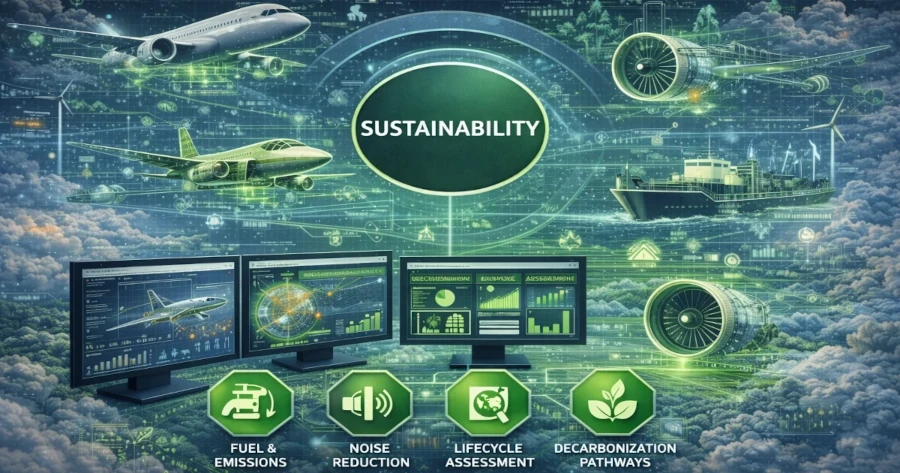
Digital twins are increasingly central to aerospace sustainability efforts, enabling detailed modeling of fuel consumption, emissions, noise, and environmental impact across full asset lifecycles. By integrating operational, engineering, and environmental data, these models allow manufacturers and operators to evaluate the effects of operational changes, new materials, aerodynamic improvements, and sustainable aviation fuels on both performance and emissions. Digital twins also support lifecycle carbon assessment and regulatory reporting by providing transparent, data-driven insight into environmental trade-offs. As decarbonization pressures intensify, they are becoming a critical tool for aligning performance optimization with sustainability objectives.
Aerospace OEMs and platform providers play a foundational role in delivering sustainability-focused digital twins by embedding emissions, fuel burn, and noise modeling directly into aircraft and fleet performance platforms. Airbus, through solutions such as Skywise and its broader digital engineering ecosystem, enables airlines and manufacturers to assess fuel efficiency, carbon dioxide emissions, and operational trade-offs across routes and fleets. These digital twins support evaluation of aerodynamic enhancements, flight profile optimization, and the operational impact of sustainable aviation fuels, allowing operators to balance environmental performance with cost and operational constraints.
Engine manufacturers are key solution providers for environmental optimization, applying digital twins to improve propulsion efficiency and reduce emissions under real-world operating conditions. Rolls-Royce, GE Aerospace, and Pratt & Whitney use engine digital twins to model fuel consumption, thermal efficiency, and emissions across varying operational profiles. These models enable operators to evaluate the environmental impact of operational changes, maintenance strategies, and fuel blends while maintaining safety and performance margins. Engine digital twins also support longer-term assessments of next-generation propulsion technologies and decarbonization pathways.
Specialist aviation analytics and MRO providers focus on operational emissions optimization and regulatory compliance. Companies such as Honeywell Aerospace, Lufthansa Technik, and Safran deliver digital twin–enabled tools that integrate flight data, environmental inputs, and system performance. These platforms support fuel efficiency initiatives, noise reduction strategies, and compliance with evolving environmental regulations, helping airlines generate robust sustainability metrics and assess the fleet-wide impact of operational decisions.
High-fidelity simulation and engineering solution providers support sustainability digital twins by enabling detailed modeling of aerodynamics, materials, and environmental interactions. ANSYS, Siemens Digital Industries Software, Dassault Systèmes, and Altair provide tools that allow aerospace organizations to simulate aerodynamic improvements, lightweight materials, noise propagation, and lifecycle emissions impacts. These capabilities support sustainability trade-off analyses early in design and continuous optimization throughout operations.
Cloud and data platform providers enable lifecycle carbon assessments and scalable sustainability reporting across complex aerospace operations. AWS, Microsoft Azure, and Google Cloud provide the infrastructure to securely process large volumes of operational and environmental data at scale. Sustainability-focused analytics firms such as Palantir and IBM complement these platforms by integrating engineering, operational, and supply chain data into digital twins that support lifecycle emissions modeling and regulatory disclosure requirements.
Emerging sustainability technology providers are extending digital twin applications to alternative fuels (e.g. Neste and Lanzajet), advanced materials (e.g. Solvay and Hexcel), and next-generation aircraft concepts (e.g. Heart Aerospace and Eviation). These providers support scenario modeling for sustainable aviation fuels, hydrogen propulsion, and hybrid-electric systems by enabling what-if analyses of performance, emissions, and infrastructure impacts. As decarbonization pressures accelerate, these solution providers are becoming increasingly important partners in translating sustainability ambitions into technically viable and economically grounded aerospace strategies.
In training and workforce development, digital twins create immersive, data-driven environments that replicate real aerospace systems and operational scenarios. Pilots, mission crews, and maintenance personnel use these twins to rehearse procedures, troubleshoot faults, and explore rare or high-risk situations without operational impact. By embedding real-world system behavior into training, digital twins improve preparedness, support skills retention, and reduce training cost, addressing workforce challenges in highly specialized aerospace roles.
Aerospace OEMs and platform providers such as Boeing Global Services and Airbus Training Services embed digital twins of aircraft systems, avionics, and operational logic into simulators and virtual training platforms. These solutions enable realistic system interaction and rehearsal of abnormal and emergency scenarios without risk to live assets. Flight simulation specialists including CAE, L3Harris, and Thales integrate OEM-derived digital twins into advanced simulators and synthetic training environments, supporting high-fidelity mission rehearsal and scenario-based training across civil and military aviation.
Defense contractors such as Lockheed Martin, Northrop Grumman, and BAE Systems apply digital twins to collective training and mission rehearsal in contested environments by combining platform models with threat simulations and command-and-control systems. Simulation and engineering software providers including ANSYS, Siemens Digital Industries Software, and Dassault Systèmes support these environments with physics-based models and digital thread integration, while immersive technology platforms such as Unity and Unreal Engine enable high-fidelity visualization.
Digital twin training also extends into maintenance and sustainment through MRO providers such as Lufthansa Technik, Safran, Honeywell Aerospace, and Collins Aerospace, which use realistic system behavior to train technicians and improve diagnostic accuracy. Cloud and XR platforms from Microsoft, AWS, and Meta enable scalable, remote access to these training environments, supporting continuous learning and workforce resilience as aerospace systems evolve.
At the program and ecosystem level, digital twins are used to model aerospace supply chains, schedules, and cost structures. These twins simulate supplier performance, logistics flows, and dependency risks, allowing organizations to assess disruption impacts and test mitigation strategies. By integrating program management data with operational and production models, digital twins improve forecasting accuracy and coordination across stakeholders, capabilities that are increasingly critical in long-duration aerospace programs with global supply networks and high exposure to external shocks.
Enterprise PLM and digital thread providers form the backbone of supply chain and program management digital twins by connecting design, manufacturing, supplier, and program data into unified environments. Siemens Digital Industries Software, through Teamcenter and related tools, enables modeling of schedules, dependencies, and configuration changes across multi-tier supply networks, allowing program managers to simulate the downstream effects of supplier delays, design changes, or production rate adjustments.
Dassault Systemes plays a similarly central role through its 3DEXPERIENCE platform, which integrates PLM, manufacturing planning, and program governance. Aerospace manufacturers use these capabilities to create program-level digital twins that link engineering baselines with supplier performance, cost structures, and delivery schedules. This supports what-if analyses of supply disruptions, alternative sourcing strategies, and production ramp-ups while maintaining traceability and configuration control.
Specialist program and supply chain analytics providers focus on risk modeling, cost forecasting, and disruption management. SAP, Oracle, and Kinaxis deliver planning and execution platforms that incorporate digital twin concepts to simulate logistics flows, supplier capacity, and inventory dynamics, enabling more resilient and responsive program execution.
Defense and aerospace primes also act as solution providers by embedding digital twins into internal program management and supplier coordination systems. Companies such as Lockheed Martin, Boeing, Airbus, and BAE Systems use program-level digital twins to manage global supplier networks, assess the impact of delays or quality issues on readiness, and align engineering, production, and sustainment planning.
Advanced data integration and analytics providers such as Palantir, IBM, and C3 AI connect disparate systems to deliver unified, predictive views of program performance. Their platforms integrate engineering, supplier, logistics, and financial data to support early risk detection, disruption scenario testing, and improved coordination across program, procurement, and operations teams.
Cloud infrastructure providers, including AWS, Microsoft Azure, and Google Cloud, support these digital twins by providing the scalable computing and data platforms required to model global supply networks in near real time. These platforms enable secure collaboration and continuous updates to schedules, cost models, and risk assessments across geographically distributed aerospace ecosystems.
Digital twins have moved from experimental engineering tools to foundational capabilities across the aviation and aerospace lifecycle. As this report demonstrates, they now underpin critical activities spanning digital certification, manufacturing optimization, fleet operations, predictive maintenance, mission readiness, sustainability, training, and program management. By unifying physics-based models, real-time data, and lifecycle governance within continuous digital threads, digital twins enable aerospace organizations to manage growing system complexity, extend asset lifetimes, and shift decision-making from reactive to predictive and model-driven approaches.
Adoption, however, remains constrained by non-trivial technical, organizational, and regulatory challenges. Sustaining model fidelity over decades-long lifecycles, integrating fragmented legacy data, ensuring cybersecurity and data sovereignty, and achieving regulatory acceptance for simulation-backed evidence all require sustained investment and cultural change. As digital twins increasingly influence safety-critical decisions, they must meet standards closer to those of operational systems than those of traditional analytics, reinforcing the need for rigorous validation, governance, and resilience.
Despite these barriers, momentum is clearly accelerating. Leading OEMs, operators, defense organizations, and space agencies are embedding digital twins into core workflows where value is measurable and risk is manageable, then expanding scope as confidence grows. The ecosystem of platform providers, simulation specialists, cloud infrastructure vendors, and analytics firms is maturing rapidly, enabling scalable deployment and cross-organizational collaboration. Regulatory bodies are also engaging more actively with model-based evidence, signaling a gradual shift toward broader acceptance of digital certification and simulation-led assurance.
Looking ahead, digital twins will become increasingly inseparable from the design, certification, operation, and maintenance of aerospace systems. Their strategic importance will continue to grow as the aerospace industry faces simultaneous pressures to improve safety, resilience, affordability, and environmental performance amid supply chain volatility and workforce constraints. Organizations that invest early in robust digital twin foundations, including data integration, model governance, and organizational capability, will be best positioned to realize long-term competitive advantage and operational resilience in an increasingly complex aerospace environment.
